 Business




Custom Round Outdoor Covers: How to Measure Curves for a Better Fit

Custom round outdoor covers look simple until the object includes [...]
Custom round outdoor covers look simple until the object includes a raised center, tapered wall, handles, controls, or an uneven base. A single diameter can describe a perfect cylinder, but many patio tables, fire pits, planters, equipment housings, and grills are not perfect cylinders. Accurate measurement begins by identifying the widest point and then recording how the shape changes from top to bottom.
This guide focuses on circular and cylindrical covers. It helps you collect useful dimensions for a cleaner fit without repeating the rectangular length-by-width method used for ordinary furniture.
Identify the actual round profile
Stand back and look at the item from the side. Is the top the widest point? Does the body flare outward near the base? Is there a domed lid, a narrow pedestal, or a control box that projects beyond the circle? The cover must clear the largest fixed feature during installation, not only match the most obvious tabletop edge.
Photograph the front, side, and top before measuring. Mark any part that can be removed or folded. A handle that detaches for storage may not need extra cover volume; a welded handle does.
Measure the maximum outside diameter
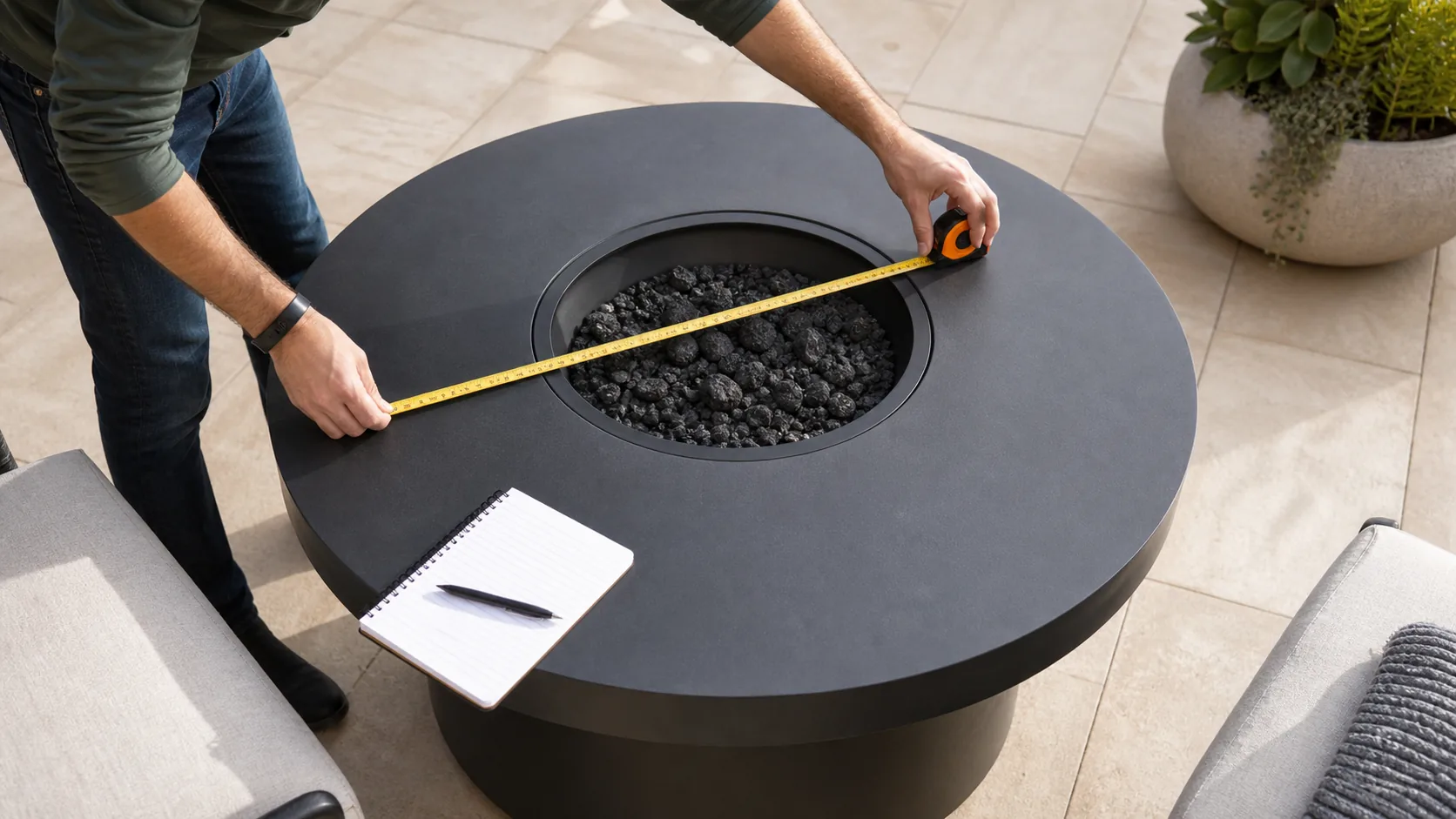
Stretch a tape measure across the widest outside points and pass through the center. Do not measure only the visible top opening of a fire pit or the inner ring of a table. The correct cover diameter is based on the outermost structure the fabric must pass over.
Take a second measurement at 90 degrees to the first. If the two numbers differ, the item may be slightly oval rather than round. Record both instead of averaging them. An oval cover needs a major and minor dimension to follow the footprint properly.
Record total height and step changes
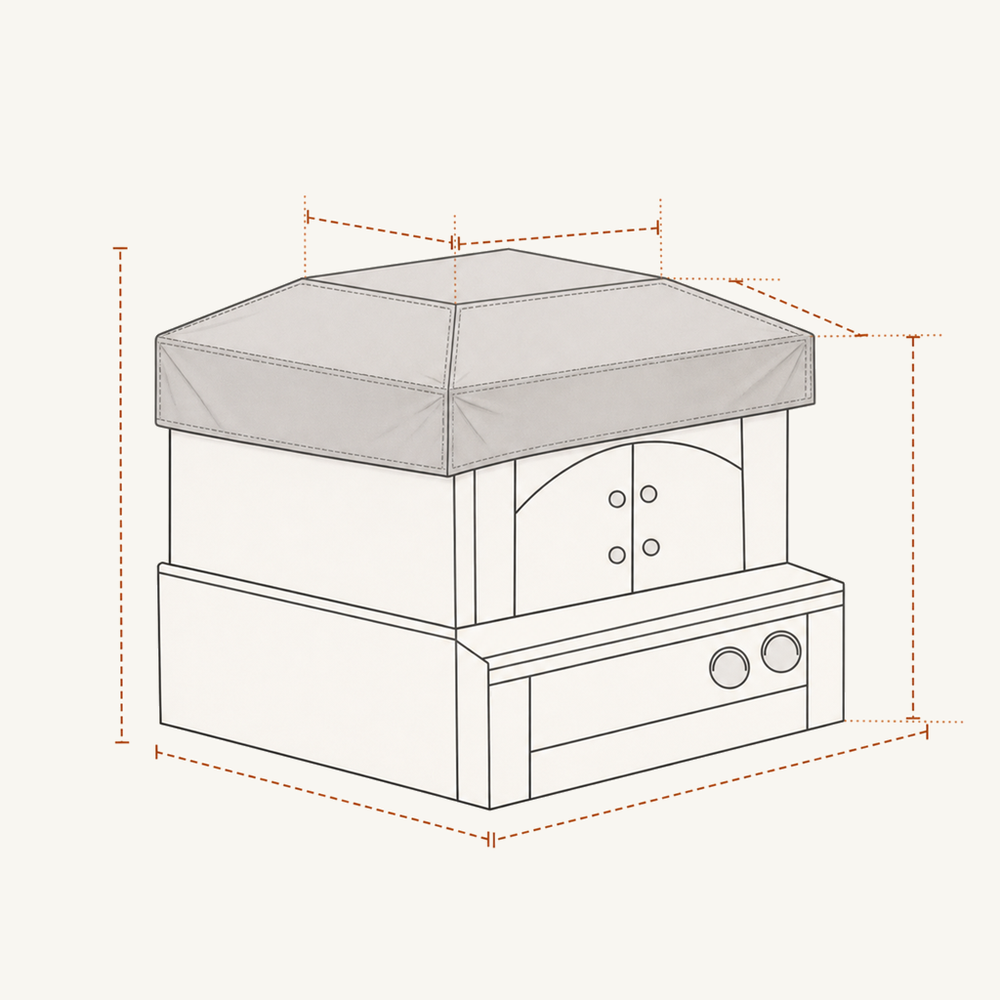
Measure from the highest fixed point to the preferred lower edge. Then record the height of meaningful transitions: the bottom of a tabletop, the widest band, the start of a pedestal, or the top of a base. These vertical checkpoints explain the profile better than one total height.
For a domed top, measure the height at the center and near the perimeter. For a fire pit with a burner lid, confirm whether the lid will always be in place when covered. For a planter, decide whether the cover protects the container only or also accommodates the plant—living plants generally require a different breathable protection strategy.
Account for projections and access points
Controls, gas lines, vents, shelves, hinges, and handles can change how a round cover installs. Measure how far each feature projects from the main body and its height above the ground. Include close-up photos with a ruler or tape visible for scale.
Some projections are better handled with a shaped pocket; others need the main cover diameter enlarged. The right approach depends on whether the feature is fragile, sharp, frequently accessed, or exposed to wind load.
Choose a practical lower edge
A cover does not always need to touch the ground. Leaving appropriate clearance can prevent abrasion and support airflow, while a lower edge closer to the base can provide broader weather protection. The decision depends on the surface, item material, and fastening method.
- Keep fabric away from hot components and allow fire features to cool completely.
- Avoid dragging the hem across rough stone or standing water.
- Identify stable points for drawcords, straps, or buckles.
- Allow enough room to lift the cover over the widest point without forcing seams.
Plan water runoff on a circular top
Large flat round surfaces can collect water in the center. A fitted cover needs either a naturally raised object profile or a suitable rounded support that creates a gentle slope. The support should spread pressure and remain stable in wind. Sharp improvised poles can damage fabric.
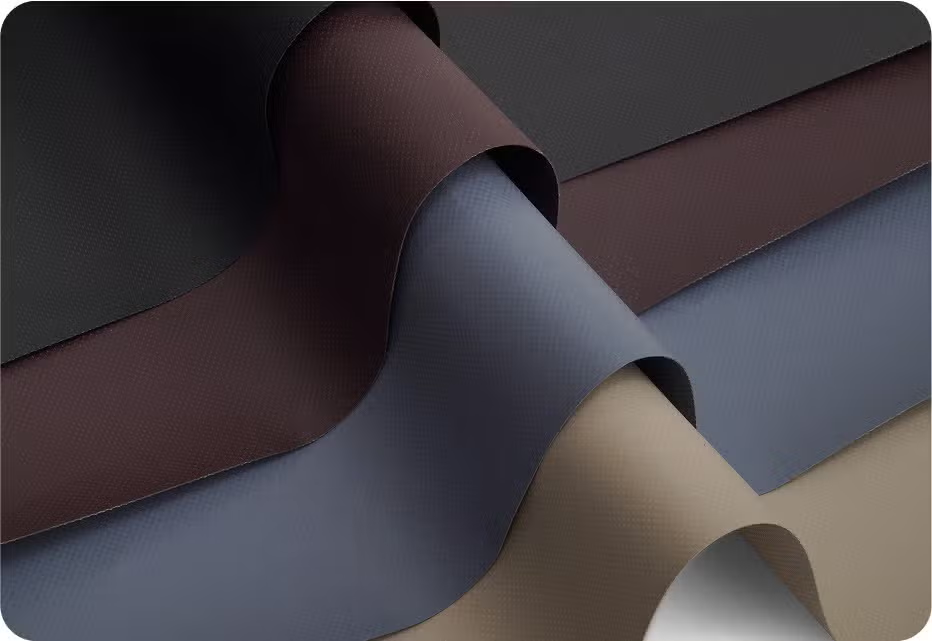
Fabric selection also matters for exposure and handling. Review the CoversForge fabric options to compare protection levels for rain, sun, and daily use.
Use a flexible tape for circumference checks
Diameter is the primary size, but circumference can serve as a useful cross-check around irregular objects. Wrap a flexible tape around the widest level without pulling it tight. If the circumference and diameter do not align closely with a circular shape, recheck for ovality or a hidden projection.
Do not substitute circumference alone unless the cover maker specifically asks for it. Diameter, height, profile changes, and photographs provide a more complete picture.
Review the measurement set before ordering
Label every number and use one unit consistently. Confirm that photos match the orientation of your sketch. The general How to Measure guide can help you organize the submission, while the round-item notes explain the shape-specific details.
Explore custom outdoor covers for circular tables, fire features, equipment, and unusual objects. If the profile changes along its height, send a sketch, dimensions, and photos through Request a Quote so the finished fit can be planned around the complete geometry.
Share This Article


